

BULK has introduced BIP-1, a new framework that will allow third-party deployers to launch perpetual futures markets with almost no upfront cost as the Solana-based exchange prepares for mainnet.
Under the model, deployers can launch up to 30 markets under their own prefix without paying for an auction or posting a large security bond upfront. Instead, markets begin in an isolated environment where deployers can establish demand before graduating into BULK’s wider portfolio margin system.
The framework is designed as an alternative to existing permissionless perpetual deployment models, where launching a market can require an eight-figure bond before the deployer knows whether traders actually want it.
BULK’s approach moves that capital requirement later in the lifecycle. Deployers can launch first, prove product-market fit, then post collateral to access deeper protocol infrastructure.
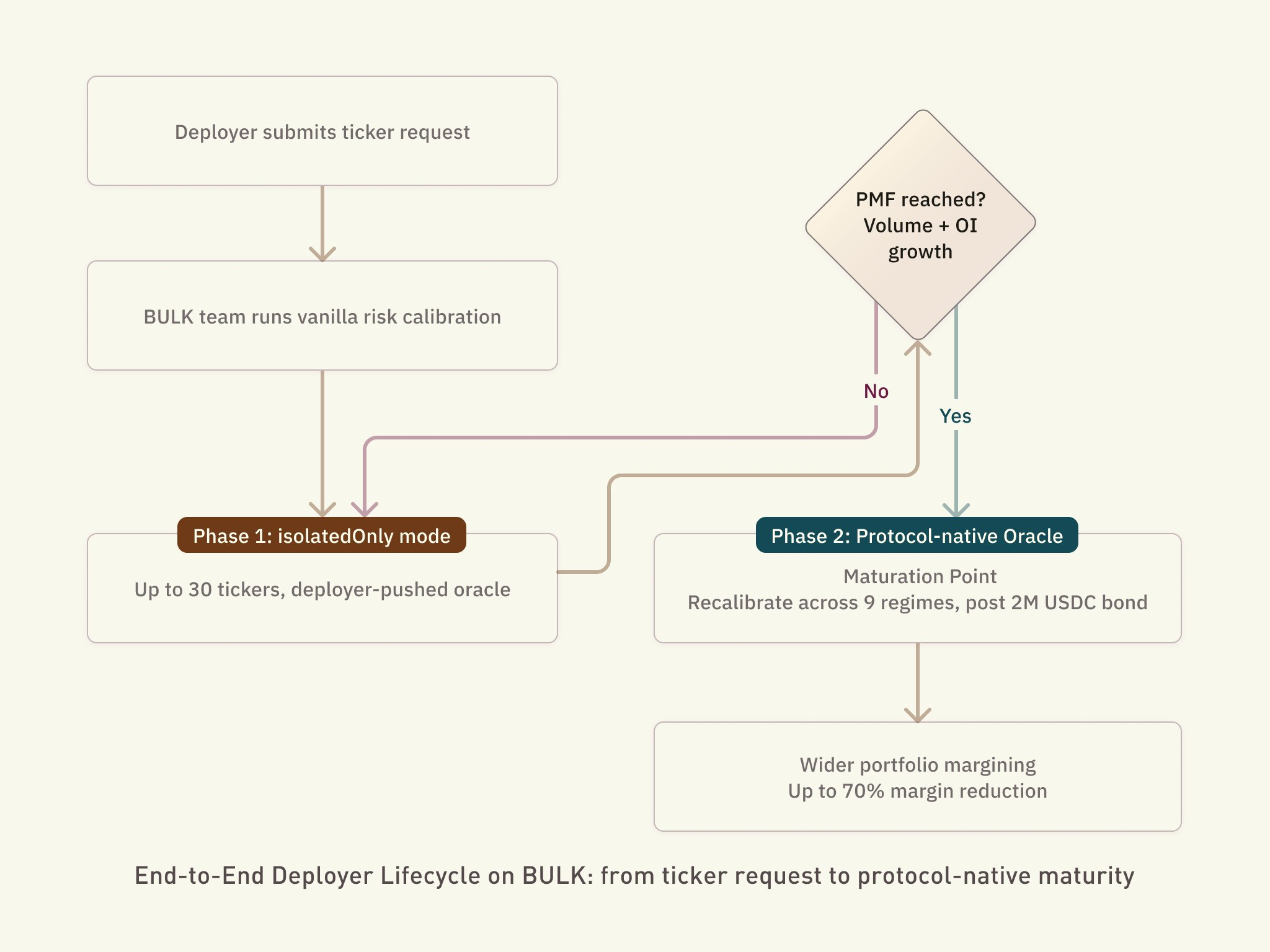
How BIP-1 Works
BIP-1 divides a deployed market’s lifecycle into two phases.
In Phase 1, markets launch in what BULK calls isolatedOnly mode. The deployer submits a ticker request, BULK performs an initial risk calibration, and the market operates separately from the exchange’s shared portfolio margin system.
Deployers are responsible for providing or delegating their oracle feed and bringing liquidity to the market. Contracts are settled in USD, and deployers cannot list assets already offered by BULK.
There is no deployment auction or upfront bond during this stage.
Deployers can also add their own fee on top of BULK’s base protocol fee, up to an additional 100% of the base rate. If the base taker fee is 3.5 basis points, for example, a deployer could charge 7 basis points in total and receive the additional 3.5 basis points on each fill. Earnings are paid every 14 days.
The structure gives teams with distribution or expertise in a particular market a way to test demand and begin earning from trading activity without committing millions of dollars before launch.
In Phase 2, successful markets graduate into BULK’s protocol-native infrastructure, where they can access the exchange’s wider portfolio margin system and no longer require a deployer-operated oracle. Reaching that stage requires sufficient trading activity and market data for BULK to calibrate the asset within its shared risk system.
Successful Markets Graduate Into Portfolio Margin
A market can graduate once it reaches what BULK calls its “Maturation Point,” determined by growth in trading volume and open interest alongside sufficient tick-level data to recalibrate the asset across the protocol’s nine market regimes.
At that point, correlations with other assets can be incorporated into BULK’s broader risk system, allowing the market to move beyond isolated margin.
That's important because BULK uses portfolio margin, calculating collateral requirements based on the risk of a trader’s overall portfolio instead of treating every position independently.
For example, BULK says a portfolio containing a $100,000 long BTC position and a $100,000 short ETH position could require roughly 60% less capital because the system recognizes the relationship between the two positions. Matured BIP-1 markets can eventually receive margin reductions of up to 70% as they become incorporated into that system.
Graduation does introduce a significant capital requirement. At the Maturation Point, the deployer must post a 2 million USDC bond to cover insurance or liquidity backstops provided by the core protocol. The bond is generally returned after five years or when the deployer settles its markets, but can be forfeited if a market is delisted for policy violations.
Once a market becomes protocol-native, BULK can take over the oracle price and work with the deployer to maintain the risk calibrations used by the portfolio margin system. The deployer continues earning through the same fee-sharing structure as the market becomes more deeply integrated with the protocol.
Lowering the Barrier to Launch New Markets
BIP-1 is here to move the largest capital commitment until after a market has proven demand.
As Kaizen wrote, "If HIP-3 priced you out, BIP-1 is the opportunity."
Instead of requiring deployers to post an eight-figure bond from the get-go, BULK lets them launch in isolation, build volume and open interest, and only then commit capital to join the exchange’s shared risk infrastructure. It's such a hell yes that we're wondering how it wasn't done before; kudos to BULK for making it happen!
With mainnet approaching, teams are getting a relatively low-risk way to experiment with perpetual markets across equities, commodities, forex, and other asset classes while earning fees from the activity they bring to the exchange.
Internet Capital Markets just got easier.