

First introduced in March 2026, Jupiter Offerbook brings a different kind of lending market to Solana.
Instead of borrowing from a pooled money market with variable rates, oracle-based pricing, and price-triggered liquidations, Offerbook lets borrowers and lenders create fixed-term credit agreements directly with each other. A borrower can lock an eligible Solana asset as collateral, borrow USDC against it, and repay by a set maturity date. A lender can choose what they are willing to lend against, what rate they want, what LTV they are comfortable with, and how long the loan should run.
That package creates a permissionless credit desk perfect for assets that traditional DeFi lending markets often ignore. Tokens, NFTs, RWAs, and even tokenized collectibles can become collateral, as long as both sides are willing to agree on the terms. It opens up a broader design space for onchain credit, especially for long-tail assets that may have value but lack the deep liquidity or reliable oracle infrastructure required by conventional lending protocols.
"Long-tail assets are ignored by DeFi. Offerbook creates a new market for them... You decide what you’re comfortable lending against, the yield you want in return, and claim the borrower’s collateral if the debt isn’t repaid on time. This is what permissionless credit looks like." - Jupiter
This guide explains how Jupiter Offerbook works, what makes it different from traditional DeFi lending, how borrowers and lenders use it, and what risks both sides need to understand before entering a loan.
Additional Resources to Note:
What Is Jupiter Offerbook & How Does It Work?
Jupiter Offerbook is a peer-to-peer credit market built on Solana. It lets users borrow and lend USDC against onchain assets through fixed-rate, fixed-term loans, with the loan terms agreed upfront by the borrower and lender.
In a typical DeFi lending market, users deposit assets into shared pools, borrowers draw from those pools, and the protocol manages risk through collateral ratios, price oracles, and liquidations.
Offerbook works differently.
There is no pooled lending market deciding the available terms, and there is no automatic liquidation triggered by collateral prices. Instead, each loan is a direct agreement between two sides. Borrowers can use Solana assets as collateral to access USDC without selling those assets. Lenders can review available offers, decide which assets they are comfortable lending against, and choose the rate, duration, and LTV they believe make sense for the risk.
Once a loan is matched, the terms are fixed, the collateral is locked, the borrower receives USDC, and the loan runs until repayment or maturity. If the borrower repays on time, they receive their collateral back. If the borrower does not repay and the lender claims after maturity, the collateral transfers to the lender.
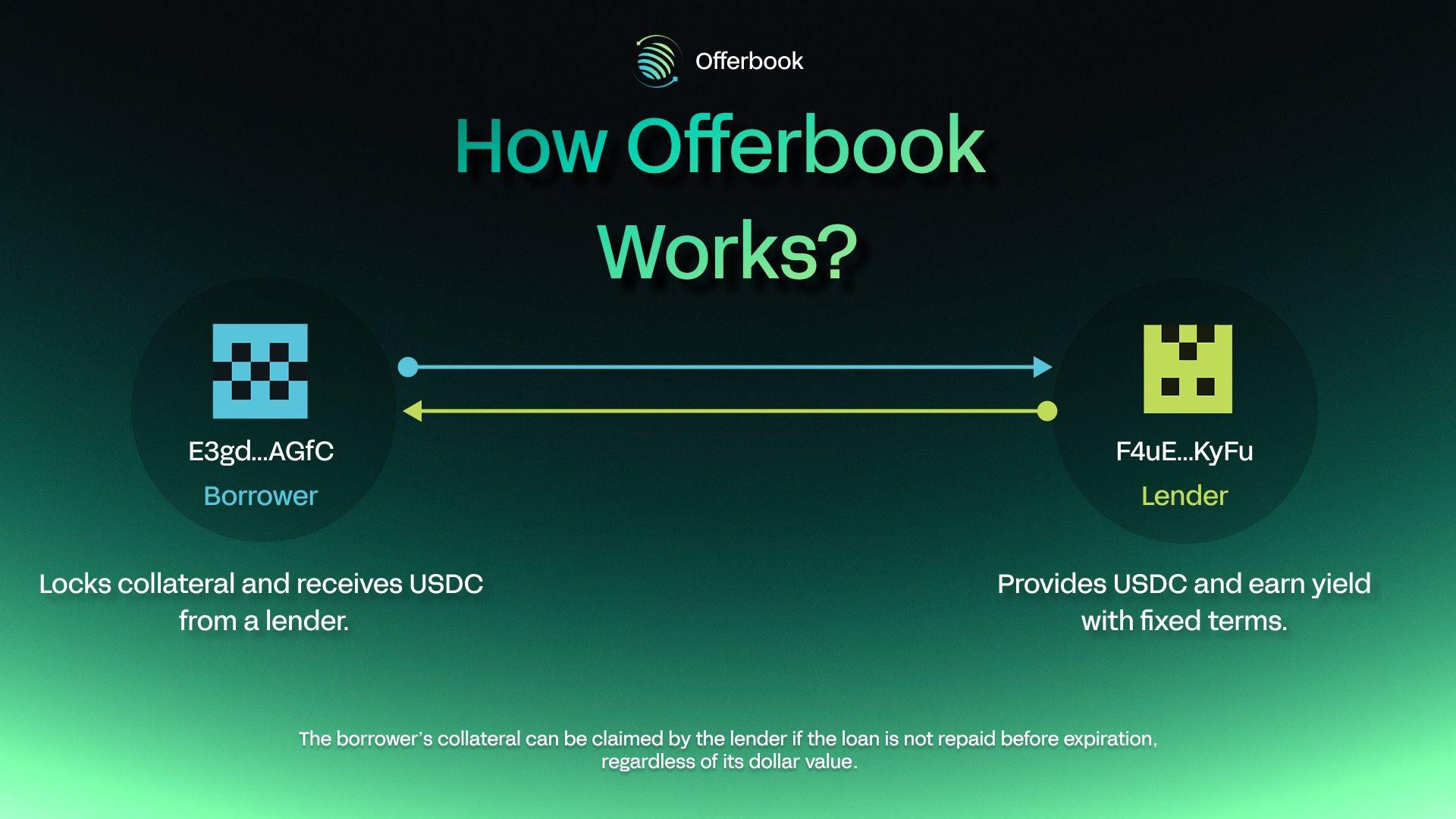
This makes Offerbook closer to an onchain private credit marketplace than a standard DeFi lending protocol. Therefore, theoretically, anything of value onchain can be used as collateral, so long as it's on Solana and both sides are willing to agree on terms.
That's why Jupiter calls it the "money market for everything onchain."
| Feature | Traditional DeFi Lending | Jupiter Offerbook |
|---|---|---|
| Market structure | Pool-based | Peer-to-peer |
| Rates | Often variable | Fixed upfront |
| Loan duration | Usually open-ended | Fixed term |
| Collateral support | Limited to approved liquid assets | Broader range of eligible Solana assets |
| Risk management | Oracles, collateral ratios, and liquidations | User-defined terms and repayment maturity |
| Liquidations | Triggered by price movement | No price-based liquidations |
| Lender experience | Deposit into a shared pool | Choose specific assets, LTVs, rates, and durations |
| Borrower experience | Borrow under protocol-set parameters | Create or accept custom loan terms |
Why Offerbook Matters for Long-tail Assets
Most DeFi lending markets are designed around highly liquid assets with reliable price feeds. That works well for major tokens like SOL, USDC, and other widely traded assets, but it leaves a large part of the onchain economy outside the credit market.
Long-tail tokens, NFTs, RWAs, and tokenized collectibles may all have value (although, at times for some, highly debatable value), but they are difficult for traditional lending protocols to support. If an asset does not have deep DEX liquidity, multiple reliable oracle feeds, or enough trading history, a pooled lending market usually cannot manage it safely. As a result, many assets can be owned, traded, or held onchain, but not easily used as collateral.
Offerbook changes that by moving credit decisions from the protocol level to the user level. Instead of requiring a protocol to approve an asset, set the risk parameters, and monitor prices continuously, Offerbook lets borrowers and lenders negotiate directly. A lender can decide that a specific token, NFT, RWA, or collectible is worth lending against; meanwhile, a borrower can decide what terms they are willing to accept. If the two sides match, the loan can happen.
That's important for DeFi because it makes credit more permissionless. Assets that would normally be ignored by DeFi protocols can now support borrowing and lending activity, as long as market participants are willing to price the risk themselves.
Your memecoins. Your stocks. Your TCG cards. Your NFTs. If it's worth something to someone, it's collateral now.
— Jupiter Offerbook (@jup_offerbook) July 15, 2026
Borrow against them without selling or be the one lending and earn on them. Fixed rate. No liquidation.
Welcome to The Everything Market. pic.twitter.com/amfL3donnx
It also creates a different kind of lending experience. Borrowers get access to liquidity without needing to sell their assets, and lenders get more control over where they deploy capital. Instead of earning a blended pool rate across a narrow set of approved collateral types, lenders can choose the assets, rates, LTVs, and durations that fit their own risk appetite.
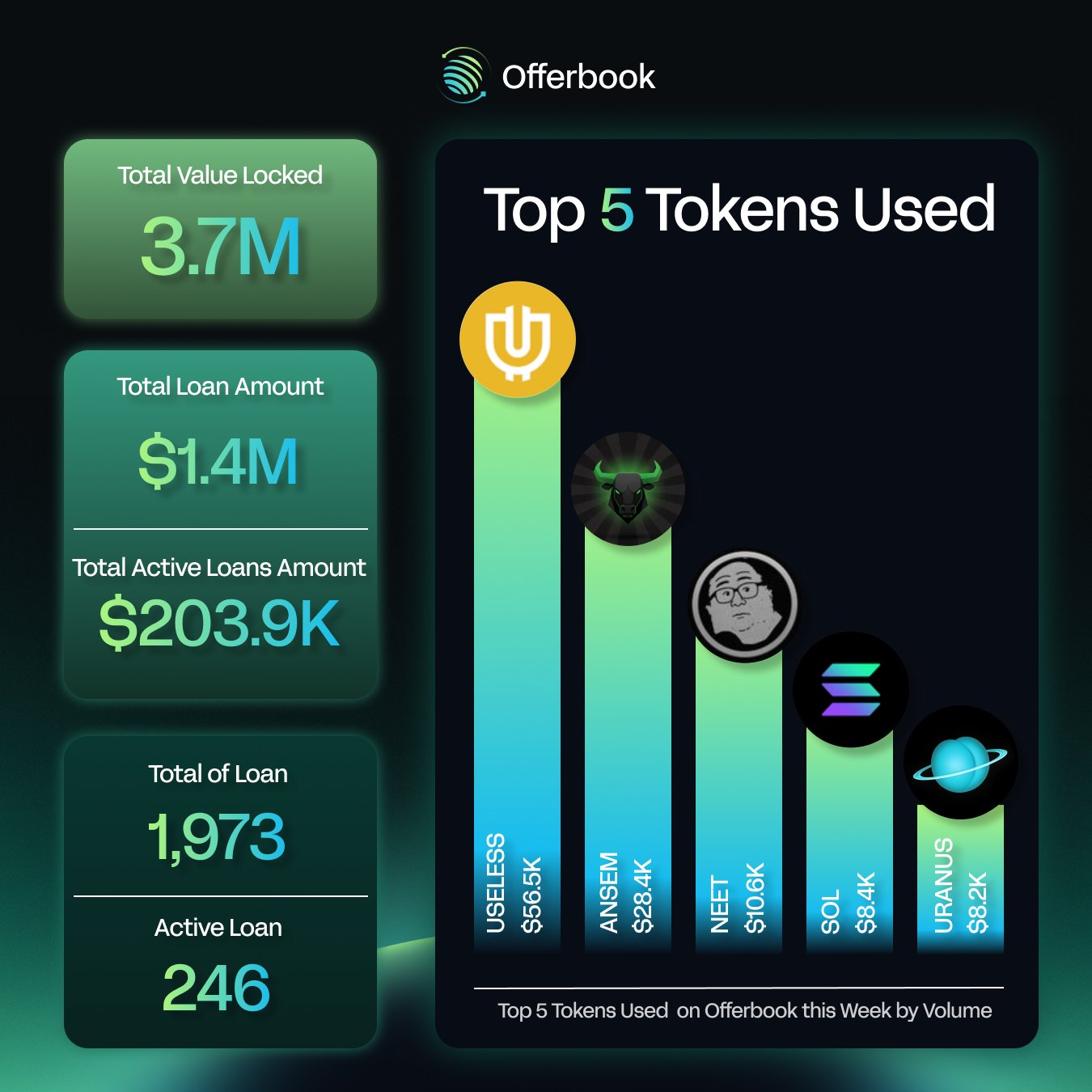
Ultimately, Offerbook works as a marketplace for negotiated credit, built around the idea that almost anything with onchain ownership and perceived value can become collateral. At time of writing, that model is showing budding demand, with Jupiter reporting $3.7 million in TVL, $1.4 million borrowed, and 1,973 loans in a recent update.
Offerbook vs. Jupiter Lend
Within the Jupiter ecosystem itself, Offerbook sits alongside Jupiter Lend, and the two are built for different needs.
Jupiter Lend is a pool-based market where lenders supply assets to shared pools, borrowers draw from them, rates float with supply and demand, positions are perpetual, and continuous price oracles drive real-time liquidations if collateral drops too far. Offerbook is peer-to-peer, so rates are fixed at creation, loans run for a set 1 to 30 day term, there are no oracles and no price-based liquidations, and USDC is the only borrowable asset.
In practice, use Jupiter Lend when you want a flexible, open-ended position with continuous monitoring and variable rates on liquid assets. Use Offerbook when you want fixed terms, no liquidation risk during the loan, or you need to borrow against an asset that a pooled market cannot support, such as an RWA, an NFT, or a long-tail token.
Learn more about the differences between the two products in our dedicated comparison article:
 Bart Hillerich
How Jupiter Offerbook Works
The sections below break down how Jupiter Offerbook works by matching borrows and lenders, from the loan lifecycle and how loans avoid price-based liquidations, to the different ways to post and negotiate terms.
The Loan Lifecycle
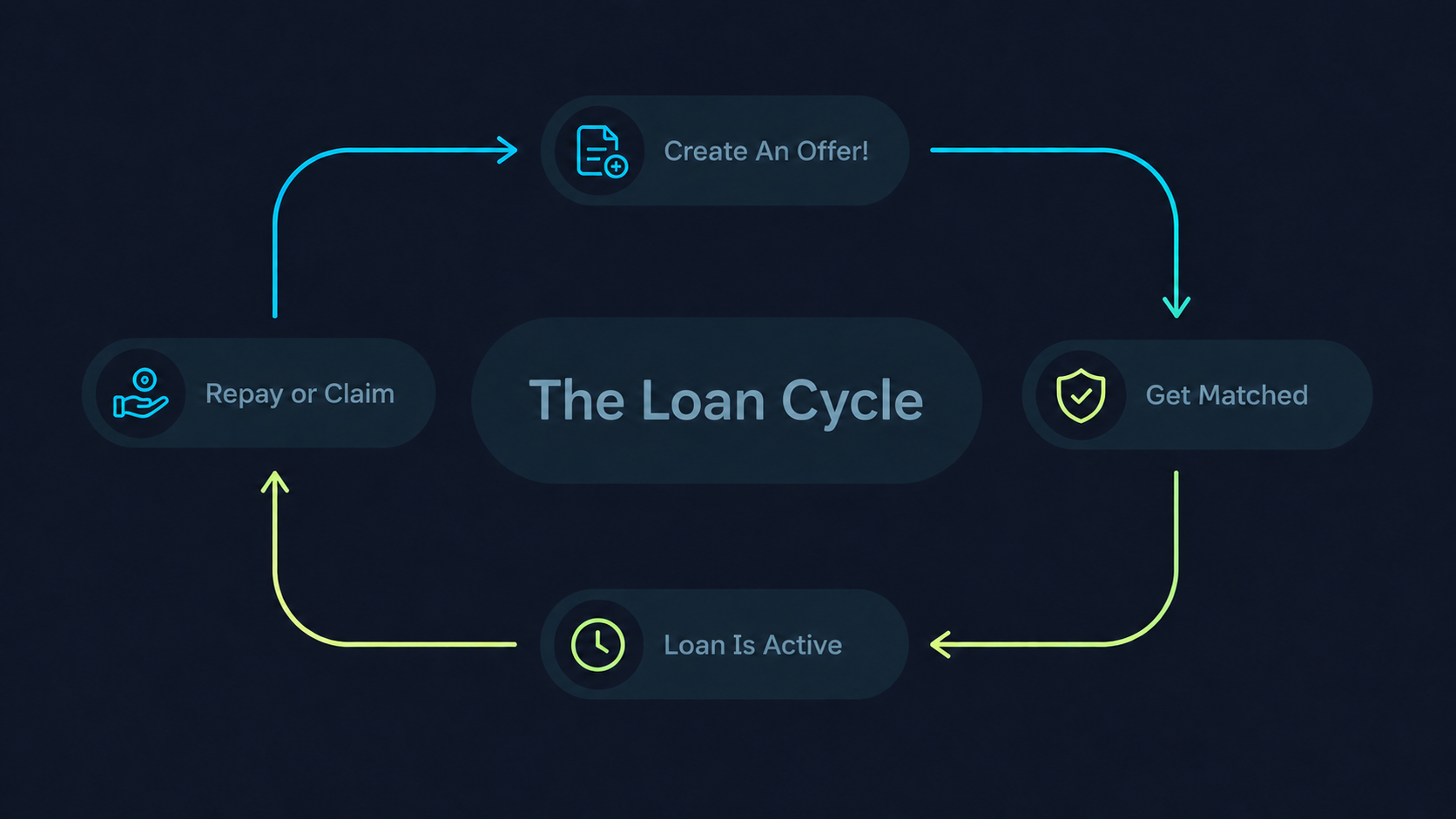
A loan on Jupiter Offerbook follows this path: an offer is created, another user accepts it, the loan runs for its fixed term, and then the borrower either repays or the lender claims the collateral after maturity. Let's dive into each phase a bit deeper.
Offer Creation
First, a borrower or lender creates an offer. A borrower might publish an offer saying they want to borrow a certain amount of USDC against a specific asset, at a certain LTV, rate, and duration. A lender might publish an offer saying they are willing to lend against a certain type of collateral under terms they choose.
Offer Acceptance
Next, another user accepts the offer. Some offers can be filled partially, which gives users more flexibility over how much they want to borrow or lend. For example, a borrower may only need part of the liquidity a lender has made available.
NFTs are the main exception because they cannot be divided into partial collateral.
The Loan Runs
Once the offer is accepted, the loan starts immediately. The collateral is locked in a smart contract, USDC is transferred to the borrower, and the agreed terms become fixed. From that point forward, the rate, duration, and collateral conditions do not change.
During the loan, there are no price-based liquidations. The borrower’s collateral may rise or fall in value, but the loan continues according to the terms that were set at the start. The borrower’s main responsibility is to repay before maturity, while the lender’s main risk is whether the collateral will still be valuable enough if repayment does not happen.
Loan Resolution
At the end of the loan, the borrower can repay the principal and interest to recover the collateral. If the borrower does not repay by maturity, the lender becomes eligible to claim the collateral. The borrower can still repay after maturity as long as the lender has not claimed yet, but once the lender claims, the collateral transfer is final.
Two Different Timers: Offer Expiration vs. Loan Duration
Offerbook runs on two separate clocks.
The first is offer expiration, or how long your published offer stays open and fillable, set between 1 and 7 days (the Create Offer flow offers 1, 3, and 7-day presets). If no one accepts before it expires, the offer simply disappears, no loan is created, and you owe nothing. Expired offers can be renewed directly from Positions > Offers without rebuilding them from scratch, with the option to adjust the LTV first.
The second is loan duration, or how long the loan itself runs once someone accepts, set between 1 and 30 days. This countdown only starts at the moment of acceptance, and once it starts, the duration is locked in.
Offer expiration governs the waiting room, and loan duration governs the loan. An offer can sit open for up to a week, but the loan clock only begins when the two sides match.
No Price-Based Liquidations
The biggest difference between Jupiter Offerbook and most DeFi lending markets is that Offerbook does not use price-based liquidations.
In a traditional lending protocol, a borrower’s collateral value is monitored continuously; if the market price of the collateral falls too far, the borrower’s position can be liquidated automatically to protect the lender or lending pool. That model depends on price oracles, liquidation thresholds, and deep enough liquidity for liquidators to sell collateral efficiently.
With Offerbook, once a loan begins, the collateral price does not determine whether the borrower keeps or loses the asset. The loan is based on a fixed agreement: a fixed amount of USDC, a fixed interest rate, a fixed duration, and a fixed repayment obligation.
If the collateral price drops during the loan, the borrower is not liquidated. If the collateral price rises sharply, the lender does not get to change the terms. The only question that matters is whether the borrower repays before the lender claims the collateral after maturity.
For borrowers, this creates more certainty. They can borrow against an asset without worrying that a short-term market move will trigger an automatic liquidation. As long as they repay on time, the collateral remains theirs.
For lenders, this changes the risk profile. Since there is no automatic liquidation system, lenders need to be comfortable with the collateral they are accepting and the LTV they are offering. If the borrower does not repay, the lender may end up owning the collateral, even if its market value has changed significantly during the loan.
This makes Offerbook less like a conventional DeFi money market and more like a fixed-term credit agreement. Price still matters when the loan is created, because it informs the terms both sides are willing to accept. But once the loan starts, repayment timing matters more than price movement.
The Escrow Wallet
Every Offerbook user has a dedicated escrow wallet, separate from their main Solana wallet, that funds move through when creating or accepting offers.
Lenders can see the escrow in the interface. USDC is deposited into the wallet as part of creating an offer, and a single balance can back multiple offers at once. When one offer is filled, the USDC leaves the escrow and any remaining offers that are no longer covered are hidden automatically. Repaid funds (principal plus interest, minus fees) return to the escrow, ready to be reused without withdrawing first, and lenders can deposit or withdraw at any time.
Borrowers do not see the escrow; it works in the background, so borrowers never have to manually manage it. Collateral transits through it automatically in a single transaction when a loan is created or accepted, and returns directly to the main wallet on repayment.
Offers, Intents, and Counter Offers
Offerbook gives users three ways to express what they want, from a firm commitment down to a free advertisement.
Offers
Offers are the core of the platform. Both borrowers and lenders can publish an offer with their own terms, including collateral, USDC amount, LTV, rate, loan duration, and partial-fill settings. An offer is onchain and can be filled immediately by a counterparty.
Published offers cannot be edited, so to change terms you cancel (free, any time before it is accepted) and relist. Many offers allow partial fills, where a counterparty can take any amount at or above a minimum fill amount the creator sets in USD, with fees applying only to the filled portion.
Intents
Intents are free, non-committal off-chain advertisements of the terms you want. An intent locks no funds, costs nothing beyond a wallet signature, and keeps your assets in your wallet. Intents cannot be filled directly; instead, Offerbook matches them against live onchain offers and surfaces the matches in your dashboard under Positions > Intents.
An offer matches an intent when the token pair is identical and the APY, LTV, and duration are all close (within 10% on rate and LTV, within one day on duration). Because intents are anchored to an LTV rather than to fixed token amounts, they stay meaningful as prices move, which is why they can be posted for far longer (up to 90 days) than offers.
Counter Offers
Counter offers let you negotiate. Instead of accepting an open offer as-is, any user can click Counter and propose a different LTV, rate, duration, expiration, or partial-fill rule. Countering a lend offer puts you on the borrowing side, and countering a borrow offer puts you on the lending side.
Counter offers lock no funds until accepted, the original offer stays open to everyone else while yours is pending, and the creator can accept one (which starts the loan immediately at the counter terms) or ignore it. Multiple counters can be open against the same offer at once.
Markets: Tokens and Collectibles
Offerbook is organized into two markets that share the same loan mechanics but differ in what you can lend against.
The Tokens market covers fungible collateral, including tokens verified on Jupiter and tokenized RWAs like xStocks. Offers backed by low-liquidity tokens carry a warning, because that collateral may be hard to sell at the quoted price if the lender ends up claiming it.
The Collectibles market covers NFTs and trading card game (TCG) collateral from whitelisted collections. Offers here are usually per item (one card, one offer), except for PFP collections with a floor price, where a lend offer can cover the whole collection. Eligible collectibles include partner items, such as physical cards professionally graded and tokenized 1:1 by Phygitals and Collector Crypt, held in insured vaults and typically redeemable for shipment through the partner. If a collectibles loan defaults, the lender receives the item itself (not its cash value), and the 0.1% transfer fee that applies to token collateral does not apply to NFTs.
Because collectibles are less liquid and their value depends on grade, rarity, and resale demand, lenders should only lend an amount they would be comfortable holding the item for.
Multiply: Leverage on Offerbook
Multiply is the leveraged side of Offerbook, packaging a regular Offerbook loan into a leveraged position, either looping a yield-bearing asset to amplify its yield or opening a leveraged long on any collateral. With Multiply, you deposit USDC, choose a leverage multiple, and the position is opened against a live lend offer, then unwound as a whole when you close.
Because it is built on ordinary Offerbook loans, a Multiply position inherits the same fixed-term, no-price-liquidation structure as ordinary Offerbook loans, but maturity matters more. In a standard Offerbook loan, a borrower can still repay after maturity as long as the lender has not claimed the collateral. With Multiply, positions have a stricter maturity profile and must be managed before the loan expires.
Example: Borrowing Against a Charizard Card
A recent example of Offerbook’s model came from a loan backed by a 1999 Shadowless Charizard card.
The borrower locked the card, graded PSA 3 and valued at roughly $1,082, as collateral. In return, they borrowed 749.5 USDC for 30 days. When the loan ended, the borrower repaid in full, the lender earned 21.56 USDC, and the borrower kept the card.
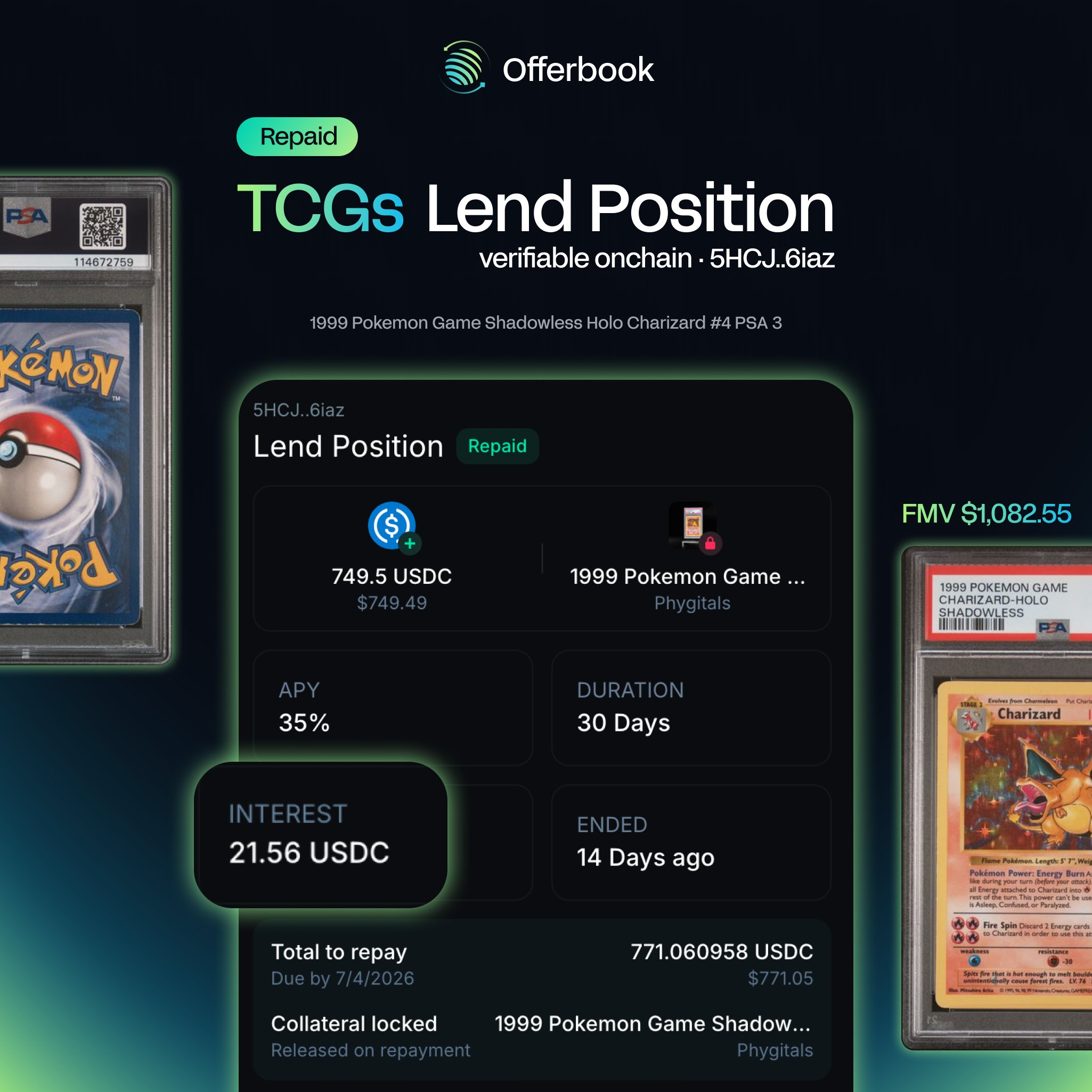
In this example, Offerbook made a collectible that would normally sit outside DeFi became usable collateral for an onchain loan. The borrower did not need to sell the card to access liquidity, and the lender was able to earn a fixed return by underwriting the asset directly.
Fees on Jupiter Offerbook
Offerbook charges fees at a few specific points in the loan process. These fees are based on the interest or collateral transfer, depending on what happens with the loan.
When a loan is first filled, the borrower pays a fee equal to 25% of the interest amount, charged when the loan begins. When a loan is repaid, the lender pays a fee equal to 10% of the interest amount. This comes out of the interest earned, not the principal that was lent.
If a loan is not repaid and the lender claims the collateral after maturity, a 0.1% fee is charged on the collateral transfer.
The fees break down like this:
| Event | Fee |
|---|---|
| Loan is filled | Borrower pays 25% of interest |
| Loan is repaid | Lender pays 10% of interest |
| Collateral is claimed after default | 0.1% of collateral transfer |
Because those fees are tied to interest, the interface shows an effective rate that folds them in, so you can compare offers on a like-for-like basis. Borrowers see a higher Effective APR than the headline rate. A 30% APR becomes 37.5% Effective APR (30% × 1.25) once the 25% upfront fee is added. Lenders see a lower Effective APY. A 5% APY becomes 4.5% Effective APY (5% × 0.9) once the 10% repayment fee is deducted. The borrow flow even prices the fee straight into the displayed APR, so the number you see when creating a borrow offer is already all-in.
Beyond protocol fees, two other costs show up when using Offerbook:
- Network fees (Solana gas): a tiny charge on every transaction, around 0.000005 SOL per signature. Never refunded.
- Account rent: a refundable deposit, not a fee. Solana requires you to fund any new account you create (your user account, an escrow account per asset, an offer account, a loan account, and so on). Most of it comes back when the account is closed. For example, offer rent is returned when the offer is filled, cancelled, or expires.
As a rule of thumb, fees are gone and rent comes back. The large SOL figures you sometimes see are usually a rent deposit rather than a cost, and if the collateral is wrapped SOL (wSOL), an explorer may show the wrapped amount sitting inside the account, which is still yours.
Intents are the exception. Posting, editing, or cancelling an intent is entirely free, with no gas, rent, or protocol fee, because nothing happens onchain. Standard fees only apply if a matching offer becomes a real loan.
The Referral Program
Offerbook has a built-in referral program that shares protocol fees. When someone opens Offerbook through your referral link and accepts it, a portion of the platform fee is redirected to you and partially rebated to them, at every stage where a fee is charged.
By default each fee is split three ways, with 20% rebated to the user paying the fee, 30% going to that user's referrer, and 50% going to the protocol. The referral applies to whoever pays the fee at each stage, so it covers the borrower at loan start and the lender at repayment and at collateral transfer.
You can customize your share link with a readable vanity slug, track earnings on your Affiliate page, and claim rewards as an onchain transaction. Rewards are paid in the same asset as the fee they came from (USDC for loan and repayment fees, the collateral asset for transfer fees).
Security and Audits
Because Offerbook supports peer-to-peer loans against a broad range of collateral, security is central to the product.
Jupiter says Offerbook was engineered with a security-first approach and has been audited by Cantina, Halborn, and Offside Labs; the full Cantina audit report (May 2026) is publicly available. These audits are important because the protocol is responsible for locking borrower collateral, transferring USDC to borrowers, enforcing fixed loan terms, and allowing lenders to claim collateral if a borrower does not repay.
Offerbook’s program updates also require multisig approval and are subject to an 8-hour timelock. This means changes to the underlying programs cannot be pushed instantly by a single actor, giving the system an added layer of operational protection around upgrades.
Still, audits and timelocks do not remove all risk. Users should treat them as part of the safety framework, not as a guarantee. Smart contract risk, implementation risk, and user error can still exist in any onchain lending product.
Risks to Understand
Offerbook removes price-based liquidations, but it does not remove risk. It changes where the risk sits.
Borrower Risk
For borrowers, the main risk is losing the collateral after maturity. Because there are no automatic liquidations during the loan, it may be tempting to think the position is safer than a normal DeFi loan. In one sense, it is: a short-term price drop will not force the collateral to be sold. But if the borrower does not repay and the lender claims the collateral, the borrower loses the asset in full.
That makes repayment timing critical. Borrowers should know exactly when the loan matures, how they plan to repay, and whether the collateral is something they can afford to lose if something goes wrong. This matters even more for rare NFTs, collectibles, or long-term holdings where the personal value may be higher than the listed market value.
Borrowers should also remember that the full agreed interest is owed even if they repay early. A fixed-term loan gives certainty, but it also means the cost is locked in from the start.
Lender Risk
For lenders, the main risk is collateral quality. Since Offerbook does not use price-based liquidations, lenders are not protected by an automatic system that sells collateral as prices fall. If the borrower does not repay, the lender may end up owning the collateral, and that collateral may be worth less than expected or difficult to sell.
This is especially important for long-tail assets. A token, NFT, RWA, or collectible may have an estimated value, but that does not always mean there is enough liquidity to exit quickly at that price. Lenders need to think about downside scenarios before funding a loan, not after a default happens.
Additional Risks
There is also smart contract and operational risk. Offerbook has been audited and uses security controls, but no onchain protocol is risk-free. Users should size positions accordingly and avoid treating any single loan as guaranteed.
Conclusion
The introduction of Jupiter Offerbook has expanded what onchain credit can look like in crypto; most importantly, it has given long-tail assets a clear path to participation.
By replacing pooled liquidity and oracle-based liquidations with fixed-term, peer-to-peer agreements, Offerbook lets borrowers and lenders decide for themselves which assets are worth lending against, what terms are fair, and how much risk they are willing to take.
Overall, the protocol gives users more control over how credit is created, priced, and matched onchain, while also making the trade-offs easier to see. Borrowers gain new ways to access liquidity without selling their assets, and lenders gain more flexibility in how they deploy capital, but both sides still need to understand the collateral, maturity, and repayment risk behind every loan.
That's the power of the money market for everything onchain.