
The Kamino Foundation receives Kamino’s onchain and offchain revenue and holds its intellectual property. It also wholly owns the entity that issued KMNO. CEO Michael Weisz outlined this structure and committed at least $20 million over the next two years to expand the Solana lending platform.
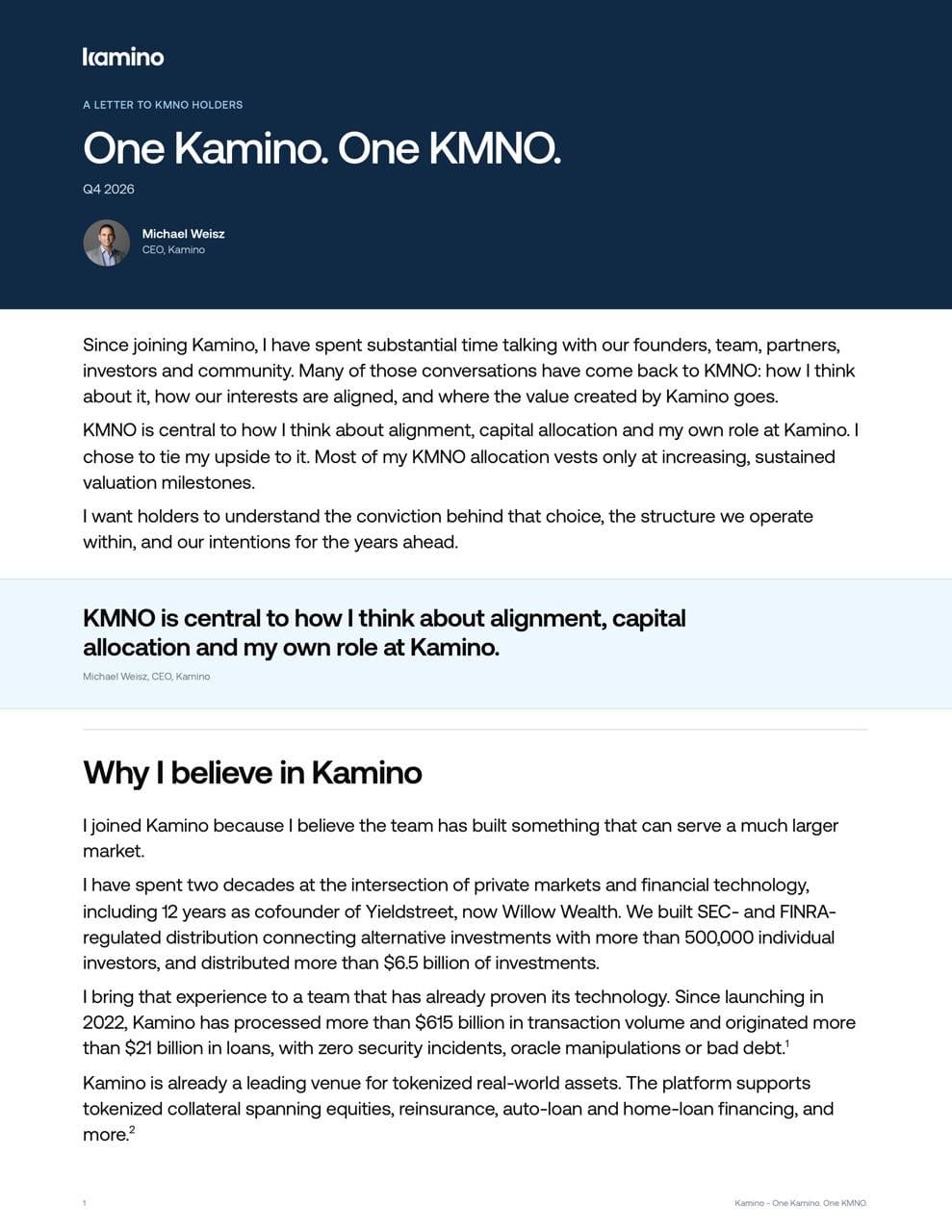
In his first letter to KMNO holders, Weisz said founders, investors, and contributors are aligned through the same token, with no separate equity allocations or additional tokens. Most of his own allocation will vest only if KMNO reaches sustained valuation milestones between $1 billion and $10 billion.
The Foundation’s immediate spending priorities are products, partnerships, distribution, and a larger team. Weisz also raised a possible buyback-and-burn program as Kamino grows, with any decision resting with the Foundation.
How Revenue Reaches the Foundation
An independent professional board governs the Foundation, which has no shareholders, members, or beneficiaries. Its constitutional objective is to support Kamino’s research, development, expansion, and use. Kamino is developing new products, institutional partnerships, and revenue streams within that structure.
Kamino earns revenue by charging approximately 10% of borrowers’ interest costs. In Weisz’s example, $1 billion in outstanding loans at a 7% annual borrowing rate would produce about $70 million in annual interest payments. Kamino’s share would be approximately $7 million.
Both outstanding loan balances and borrowing rates affect Kamino’s revenue because the fee is calculated on the interest borrowers pay. The figures in the letter are a hypothetical example of how the fee works.
The $20 million commitment will fund expansion over 24 months, and the Foundation holds significant reserves beyond that amount. Weisz also plans to broaden Kamino’s revenue sources with additional products.
Growth Spending and a Possible KMNO Buyback
“As Kamino scales, our goal is for the Foundation to build the financial capacity to support KMNO alongside continued investment in growth,” Weisz wrote. “That could include a buyback-and-burn program that reduces token supply.”
A buyback-and-burn would use Foundation resources to acquire KMNO and remove tokens from supply. The Foundation’s finances, investment priorities, and applicable regulations would determine any program’s form and timing. The $20 million commitment funds growth; a token buyback remains a possibility subject to the Foundation’s decision.
CEO Vesting Depends on Sustained Valuations
A smaller portion of Weisz’s KMNO allocation vests over time, while most of it depends on KMNO reaching progressively higher fully diluted valuation, or FDV, milestones between $1 billion and $10 billion.
FDV measures a token’s valuation using its price and total supply, including tokens outside the circulating supply.
“Each milestone must be maintained over time. A temporary price increase does not satisfy the requirement,” Weisz wrote.
Future team compensation will follow the same approach, with a significant portion of each person’s KMNO vesting tied to increasing, sustained FDV milestones alongside individual performance.
The Tokenized Lending Plan Behind the Investment
Kamino supports tokenized collateral in equities, reinsurance, auto-loan financing, and home-loan financing. Weisz wants to connect its lending infrastructure to banks, brokerages, retirement platforms, digital wallets, and wealth managers so investors can borrow against assets held through those channels.
His targets include capturing 10% of the tokenized real-world asset market in the short to medium term and 20% by 2030. Separately, he outlined an illustrative path to approximately $50 billion in outstanding borrows by 2030, roughly 50 times the level cited in the letter.
That borrowing scenario starts with Kamino’s projection of a $2.3 trillion tokenized asset market. It assumes about 20%, or $460 billion, is eligible for borrowing, that asset owners want financing, and that Kamino captures 10% of that opportunity. Ten percent of $460 billion is $46 billion, rounded to roughly $50 billion in the scenario. Actual loan balances would also reflect collateral requirements and available liquidity.
Weisz plans to report progress through the value of tokenized assets supplied, stablecoin liquidity deposited and borrowed, and the volume of assets bought and sold through Kamino’s infrastructure.