

Morgan Stanley has launched one of the cheapest institutional investment products offering exposure to Solana, sharpening attention on what RockawayX CEO Viktor Fischer sees as a significant gap between SOL’s market position and the amount of institutional capital allocated to it.
The Morgan Stanley Solana Trust began trading Tuesday on NYSE Arca under the ticker MSOL. The product carries a headline expense ratio of 0.14%, below the fees charged by every other spot Solana exchange-traded product currently trading in the United States.
In a post published ahead of the launch, Fischer described Solana as a “major” crypto asset that has yet to receive institutional investment on the same relative scale as Bitcoin and Ethereum.
“Unlike BTC and ETH, SOL has not yet had the institutional capital inflow,” Fischer wrote.
His argument was based on spot ETF assets under management as a percentage of each asset’s market capitalization. Fischer noted that Bitcoin spot ETFs represent approximately 6% of Bitcoin’s market cap, while Ethereum products account for around 4.5%. For Solana, the figure stands closer to 2%.
That implies that Solana’s regulated investment products remain relatively undercapitalized, even after accounting for SOL’s smaller overall valuation.
Morgan Stanley Sets a New Fee Floor
MSOL’s 0.14% expense ratio makes it materially cheaper than the existing field of spot Solana ETFs.
Franklin Templeton’s SOEZ and the Grayscale Solana Trust currently sit at 0.19%, while Bitwise’s BSOL charges 0.20%. Fidelity’s FSOL carries a 0.25% fee, VanEck’s VSOL charges 0.30%, and other products range as high as 0.50%, excluding temporary promotional waivers.
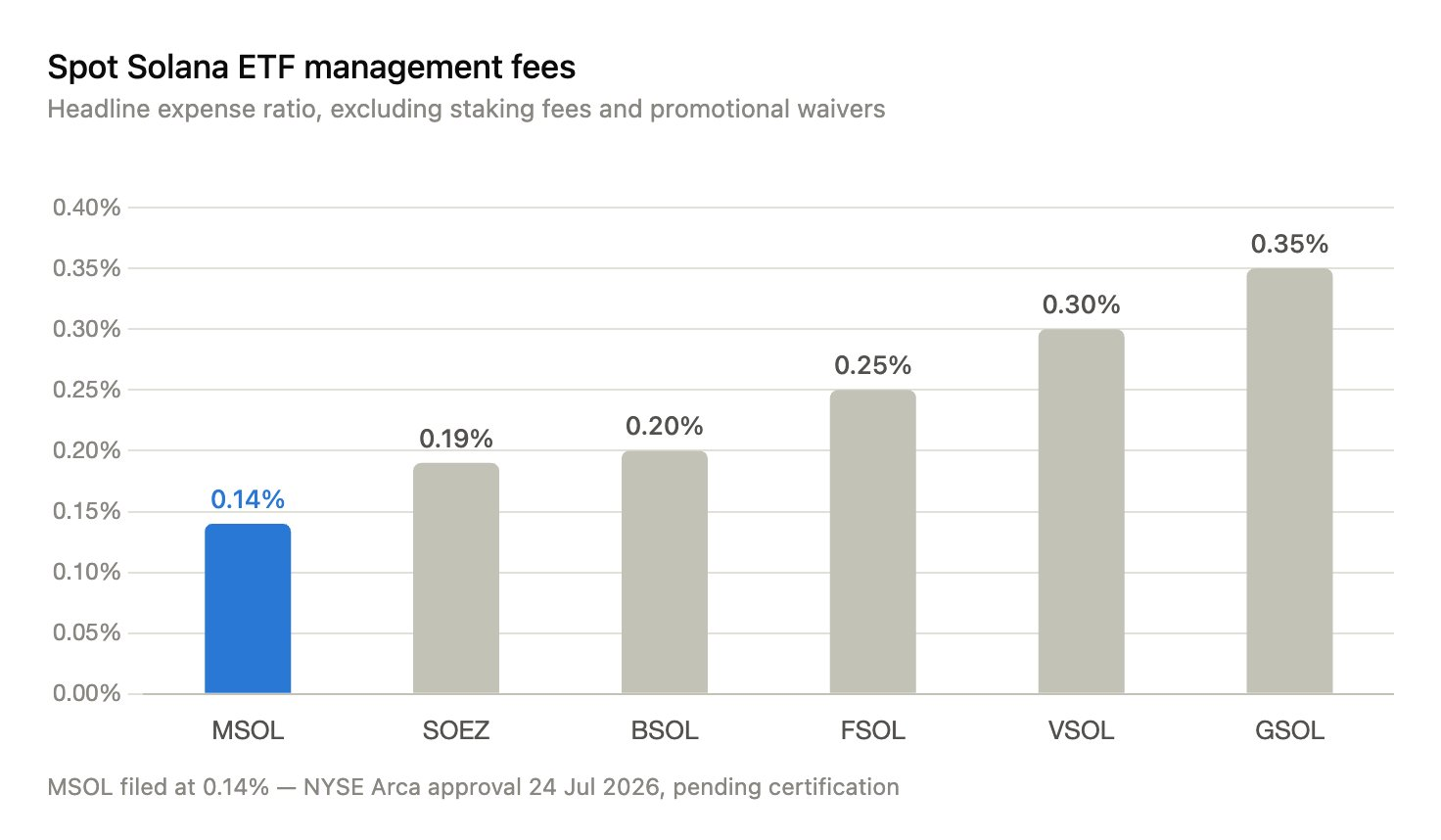
That means Morgan Stanley is not simply entering the Solana ETF market; it is immediately attempting to compete on price.
Fischer highlighted the fee as a potential catalyst for the next phase of SOL institutional adoption.
“Let’s see what it does to that gap,” he wrote.
Low fees can matter considerably in an ETF market where competing products offer exposure to the same underlying asset. While brand, liquidity, staking policy and distribution all influence investor decisions, the expense ratio represents a predictable annual drag on returns and can become increasingly important to long-term allocators.
Morgan Stanley also brings a distribution network and institutional reputation that many crypto-native issuers cannot match. Its arrival could, therefore, expand the pool of investors considering SOL exposure.
MSOL Includes Exposure to Staking Rewards
The Morgan Stanley Solana Trust is designed to track the price of SOL while also reflecting rewards earned by staking a portion of the assets held by the product.
Morgan Stanley’s filings state that the trust intends to begin staking in connection with the offering. Custodians will delegate the designated SOL to validators, while the assets and resulting rewards remain associated with the trust’s segregated custody accounts.
This structure is particularly relevant for Solana because staking is a fundamental component of the asset’s economics. A product that holds SOL without staking may underperform direct ownership over time because investors miss the rewards available to participants who help secure the network.
You can learn more about SOL staking in Sanctum's institutional strategy guide:
 Bart
Bart
Solana’s Institutional Opportunity
Fischer’s broader point is not that institutional interest in Solana is absent. The expanding ETF market, the entrance of firms such as Morgan Stanley and the presence of products from Fidelity, Franklin Templeton, Bitwise and VanEck all demonstrate that SOL has become an established part of the regulated digital asset landscape.
The argument is that adoption is still early relative to Solana’s position in the crypto market, something highlighted in RockawayX's 2025 "Why Solana?" report, which outlined the SOL bull case for Wall Street.
Morgan Stanley’s entry will provide an important test. Let's see how much demand has been waiting on the sidelines.